

Have you noticed this?
Companies keep coming up with different ways to “help” employees, like wellness programs, gift cards, pizza days, and meditation apps. Yet, even with all these things, people still feel burned out or disconnected.
Why?
While these solutions try to fix everything else around us, they don’t give employees the tools to actually make an impact themselves.
The real issue isn’t about making employees more resilient or pushing individual wellness. It’s about creating a place where everyone supports each other. If we’re all focused on fixing ourselves, no one’s fixing the culture as a whole.
Who’s supposed to fix it?
Usually, the pressure falls on leaders. But pressured leaders lead to pressured employees. Now, let’s face it, not all leaders are like Jordan Belfort giving a motivational speech on “The Wolf of Wall Street”. Not everyone has an aura of inspiration around them to bring a sense of belonging and a united front of meaningful work. To be fair, most leaders don’t have the budget, the time, or the vibe to turn things around alone. But together, we can inspire the same culture if we have the right tools to do it.
The Gratitude Network
I’ve been looking at the symptoms of burnout, and I realized that the main reason people burn out is that they don’t feel seen or appreciated, and that can be translated by a lack of consistent feedback about their work.
That’s why I developed a system called The Gratitude Network.
Do you remember Pay It Forward? (the movie or just the principle) It’s when someone does something for you for free, you then do it for 3 others, until the entire community starts helping each other.
The Gratitude Network is quite similar, it’s about shaping a culture of support. Now, how does it work?
The Gratitude Form
When someone helps you, you open the Gratitude Form, select the employee(s) that helped you, and write a personal text to them. Easy, right? It takes 15 seconds, and let’s be honest, you already thanked them on Teams, in the Email, or in that last meeting you had.
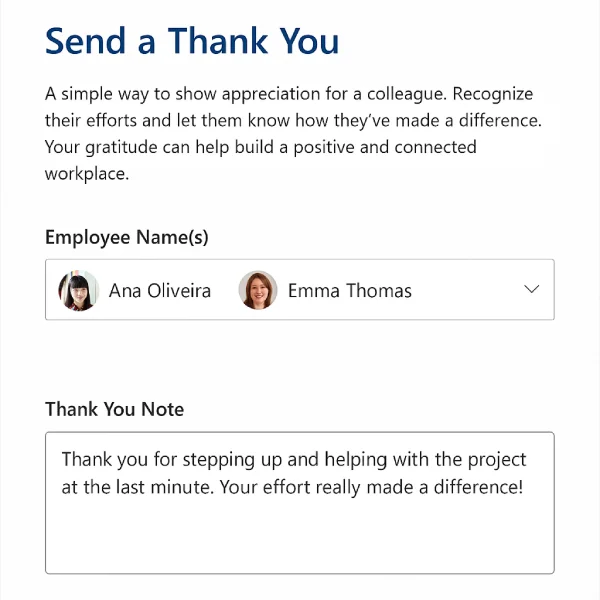
Now, why should you use a fancy form to thank someone? What’s the point? Well, Teams and Outlook are great communication tools, but there is only one small problem. All the gratitude goes away with the next urgent task. Now, what does the Gratitude Form do differently?
The Gratitude Journal
It keeps track of all the recognition you receive from your colleagues! And the gratitude you’ve shown them as well. It’s all stored in your personal impact space, what you are most appreciated for, a self-reflection tool, and most importantly, a tool to see the great people you collaborate with every day and appreciate you.
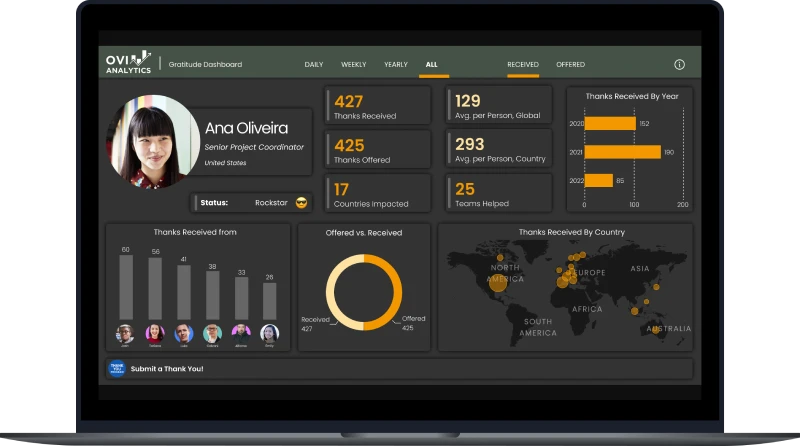
It gives meaning to your work, builds trust, and shifts the culture to meaningful connections. Think about apps like Waze (where the community participates by pointing out what happens in traffic) and Google Reviews (where people find your review useful before visiting a place). It is community-based, and it is building a culture of intrinsic care.
What about the business?
This alone is a project that inspires engagement and increases retention rates. Because you offer employees a tool to connect, to form long-lasting relationships, and to receive consistent peer-to-peer feedback. You offer your employees a tool to succeed and see what success looks like.
What else can you do with this setup?
- Measure real engagement (using summary data, like in each city/country or region) – This could be available internally to everyone to encourage adoption.
- Use it as a continuous improvement insight engine – where a dedicated team identifies hidden problems (for example, if there are 10 different employees grateful to someone who solved their access issues, you might want to check for a cause and a permanent fix).
- You could use it as a recognition program, but once there are incentives involved, it might backfire and become a distraction from work rather than actually boosting productivity. For the same reason, I DO NOT recommend using it for Annual Reviews.
- Build a community on the Intranet where people can share screenshots of their board and brag about their achievements.
It’s important to respect employees’ privacy and be transparent about how this tool will be used at a global level. Keep it honest. Keep it human.
Let’s build the culture we all wish we had
- Recognition shouldn’t be rare.
- Appreciation shouldn’t disappear in a chat thread.
- And culture? That’s not HR’s or Leaders’ job alone. It’s everyone’s.
Do you want The Gratitude Network in your organization?
Let’s talk. Use the live chat to get in touch today.


No responses yet